
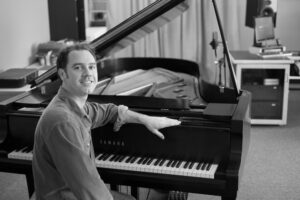
My newest chat is with Ceiri Torjussen from Wales, who is living his dream in California. Film scores and television work both feature prominently on his impressive resume. He’s an Emmy Award nominee for Dive Olly Dive (an animated series).
We talk about the challenges and joys of composing. He shares three facts with me, which I ask of everyone. Read on to learn what those are and his journey as a composer.
Introducing Ceiri…
Welcome to my blog, Ceiri. Thank you for being a part of it. Okay, let’s start off with one of my favorite questions. What do you love about your life right now?
First of all, I feel very lucky that I have a beautiful family (a wife and 10yr old daughter) and that we live a happy life in Topanga, CA. I love that I get to make a living doing what I enjoy most–creating music, and working with other musicians, artist and filmmakers. I also love boogie boarding in the ocean and hiking in the Santa Monica Mountains. Warm ham and cheese croissants are also something I love.
From what I know about film composers, your way of storytelling is through your music. When did your journey of composing music begin? Also, was this your dream as a child to be a composer?
I started playing trumpet and piano at around 7ys old (followed by tenor sax and Indian tabla for a while). I started to specialize in trumpet, playing in orchestras and jazz bands, and continued it right through college. It sort of became my dream, since around the age of 12, to dedicate my life to music. I guess I realized that composing was my passion as a teenager, even though I’d only started writing some (very dodgy!) early pieces. I continued composing until I realized that this was the thing that I enjoyed doing most, so I decided to pursue it professionally.
Was there a particular film that inspired you to become a composer?
There were a few, but I think one of the most influential for me was Kubrick’s 2001: A Space Odyssey. Ironically, there was no original music in this film since Kubrick sadly rejected Alex North’s commissioned score in place of his original ‘temp score’. However, this temp score worked so brilliantly with the picture that I can see why Kubrick made that choice. (By all accounts, Kubrick didn’t handle the situation very well with his composer, North, but that’s another story). Anyway, it was in this film that I first heard the music of György Ligeti, which completely captivated me. It was so evocative and cosmic, and worked so perfectly to picture. What’s amazing is that Ligeti had written those pieces (his Lux Aeterna, Requiem, etc.) several years prior, and had probably never even thought about outer space while composing them. Nevertheless, the marriage of his music to Kubrick’s iconic imagery was pretty groundbreaking, and was definitely an inspiration for me as a young composer trying to find his way. Also, the use of Johann Strauss’ Blue Danube Waltz for the rotating spaceship and Richard Strauss’ Also Sprach Zarathustra were inspired choices that have since become iconic uses of music to picture.
In my opinion, the music and film score are just as important as the actors and the screenwriter. The right music can enhance a film. Without a score, films feel incredibly awkward or empty to me. It’s the invisible glue that connects the script, the acting, and the cinematography into a wonderful, cohesive emotional journey. What are your thoughts on that?
Didn’t Spielberg say that, for him, music accounted for 50% of a film’s success? Well, that’s easy to say when your composer is John Williams! 😊. But in general, yes, I agree entirely: music can be an incredibly powerful filmmaking tool. Films with scores are our modern-day operas (but without the singing). I’ve no doubt that if Richard Strauss or Wagner were alive today, they’d both be writing film music. Hollywood scores especially give us an aural throughline through the film which ‘guides’ the viewer’s emotional reaction to the drama. Frankly, it’s a type of artistic manipulation, where the director can try to enhance how we ‘feel’ in a certain way towards a certain scene or character (just like operas do). Some films do this more blatantly than others, but it’s our job as composers to accomplish the director’s artistic vision, whatever that may be. All that said, there are some excellent films which have no score at all, (e.g. Hitchcock’s The Birds, or Lumet’s Dog Day Afternoon), so I think it very much depends on how much music a film needs, and how that music should function on an emotional level.
One reason I love films is because of the film score, especially the one from Braveheart and Gladiator. I was listening to your music while I was researching for our interview and enjoyed the different styles. Your range is massive! I especially enjoyed listening to Funky Monkey (playful and funky) and Delhi Crime (dramatic with layers of suspense). Your musical abilities and talent are not limited to just one genre. You have composed music for romcoms, animations, horror, dramas, and romance. How do you prepare to compose for a film or TV show? What’s your process?
First of all, lots of coffee, and often panic. Haha! One joy of my job is that one project is often completely different from the last one. This keeps things fresh for me and stops me from getting bored. I think we do our best as artists when we’re given variety and when we stretch or technical capabilities. Scoring crime thrillers, horror, and dark dramas are probably what I’ve done most of. However, when I work on a comedy or an animated show, it can light a spark in me that is artistically refreshing (after all that darkness!). Scoring comedies is definitely fun, but it’s also really difficult. Like horror, it’s all about the timing, and about when or when not to ‘play the joke’ in the music. That’s an art in itself.
On the musical level I’m a very eclectic listener, and as a musician, have played in many musical genres–classical, jazz (and related subgenres), funk, soul, rock, electronic music, north Indian classical, Javanese gamelan, etc. Added to that I regularly listen to music of diverse genres and nationalities, so having an eclectic approach to music-making is at the core of who I am as a composer. All of this helps me when I’m required to create a score in a style in which I’ve never worked. It’s a challenge that I relish.
You’ve scored both bone-chilling thrillers like The Canal and campy monster movies like Big Ass Spider! When you sit down at the keyboard, how do you mentally shift gears between orchestrating pure terror and composing tongue-in-cheek cinematic fun?
Actually, sitting down at the keyboard is often not the first thing I do. I’ll usually watch the film first (or read the script) several times: try to soak in the story and really get inside the characters. Then I’ll often think away from the studio–often on long walks. Only after I feel like ideas are starting to come to me do I sit in the studio or at the piano and start to sketch them. I’ve learnt that often the best ideas come when you’re not trying too hard–or even thinking about something completely unrelated. So long as I’ve done my homework and have a good sense of what the project is about, often the best ideas come when I’m least expecting them.
But to answer your question: how do I “shift gears”? This has just become a knack I’ve developed over 30 years of composing professionally. It can definitely be jarring, jumping from a light comedy to a horrifically scary scene, but for me this challenge is half the fun of doing what I do. Just as many directors like variety, I think I’d get bored if every film I scored was in the same genre.
One show you’ve scored is Delhi Crime, which won an International Emmy Award and once trended in Netflix’s top 10. Delhi Crime deals with incredibly heavy, real-world events. As a composer, how do you approach a project like that to ensure the music honors the gravity and realism of the story without accidentally making it feel too “Hollywood” or melodramatic?
Concerning the recent season (3) of Delhi Crime, it was definitely a challenge to score the plight of the young girls who were being abducted and trafficked in an emotional way but without veering into melodrama. That was always a balance that I and Tanuj Chopra (the director/showrunner) had to be aware of. Their sound needed to be at the same time sad (tragic even), but also unsettling, scary, and creepy at times. We follow their storyline through every episode, so I needed to reflect both their sorrow and their struggle for survival. Their sound was more acoustic and less synthetic. It was often softer, slower, and breathier (using bansuri–an Indian flute – and sometimes the female voice). Strings and gentler melodic instruments (e.g. piano and harp) were also used to score the captured girls, and their sound was the polar opposite to the music I wrote for the villains in the story.
How did you become involved in composing the score for Delhi Crime?
I’d worked with Tanuj on several smaller projects previously, and he and I were also working on his latest feature film, Hummingbird. We loved collaborating, and Tanuj very graciously recommended me and brought be on board the show.
The Los Angeles Times once described your music as a ‘sudden bolt of creative lightning.’ When you are facing a tight industry deadline and a blank page, what is your personal ritual for forcing that lightning to strike on command?”
I guess more than anything it’s adrenaline and pure terror at the thought of not delivering! 😉
What are some challenges and joys of composing?
The challenges are endless–creative blocks, fear of repeating oneself or not sounding original, technical studio gripes, etc. The joys are that I get to earn a living doing what I love (and the only thing I know how to do!). Also working with my amazing musician friends to record my music is always very special to me. Live players always bring a different life to the music that it never had while it was sitting inside a computer.
Is there any advice you would give to someone who wants to pursue a career as a composer?
Be nice, be honest, be original, be persistent, and never give up. Oh, and learn all your scales!
Failure is such an important part of any creative journey. Can you share when something didn’t go as planned in your career, what it taught you, and whether there’s a particular ‘failure’ you now look back on with gratitude?
I think it depends on how you define “failure”. Sometimes when I don’t land a job, I might later find out that it wasn’t due to my music, but because of other factors–e.g. relationships, specific types of experience/credits, etc. So in those cases my “failure” wasn’t creative but was instead not being as well connected as the other person. My lesson in those instances is: I need to get out of the studio and meet more people!
As far as “creative failure” I really don’t believe in that. A work of art doesn’t in itself succeed or fail. Individuals can only judge artworks, and those judgements are always just opinions. If I wrote something that I thought was good, it doesn’t mean that someone else would feel the same way, and once I send it out into the world, other people’s opinions are out of my control. All I can do is produce music that I think is good, and hope that others will agree with me.
If you could have a gigantic billboard anywhere with anything on it, what message would you want to convey to millions? What would it say and why?
“Climate change is real. (Because we need to fix it. )
Describe yourself in one word.
Ceiri
Ceiri, this is one of my favorite parts of the chat. Share three fun facts about yourself.
I speak Welsh.
I’m a White Druid of the Island of Britain.
I love water parks, though I’m conflicted about their environmental impact and this inner conflict tortures me.
I love ending the chat with a quote. Do you have a favorite quote or saying that has inspired and motivated you in your life that you can share with my readers?
It’s a Welsh proverb – “dyfal donc a dyrr y garreg”. (trans.: persistent knocking breaks the stone).
Thank you for reading my chat with Ceiri. Check out his website: here.