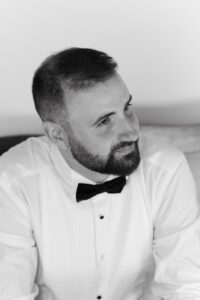
My newest chat is with Simone Cilio, an Italian film composer, who has been in the industry since 2013. He has won an Emmy for the documentary, The Last Signal for Best Documentary.
Besides winning an Emmy, he has won over 30 awards and is a sought-after composer in the film industry with over 100 feature film credits. He’s worked with brands like Volvo and Audi. His work is impressive and speaks for itself with all the wins he has.
We talked about the latest film he wrote the score for, and the challenges and joys of composing. He also talked about failure with me, which I love his thoughts on. Learn more about Simone in our chat.
Introducing Simone….
Thank you, Simone, for joining me on my blog. What do you love about your life right now?
Thank you for having me, Maria!
What I love most about my life right now is the fact that I can continue to make music and, through music, tell stories. Every project gives me the opportunity to enter a different world, work with different people, and discover something new about myself as an artist. I also love the balance between my professional life and my family. My family has always been a very important source of inspiration for me, and I try never to take for granted the opportunity to do what I love for a living.
Your love of music started when you were 6, when you started playing the drums, and you later added other instruments, including the bass guitar. Do you have a favorite instrument?
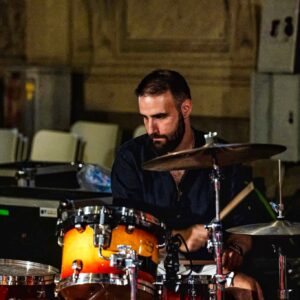
Drums will always have a very special place in my heart because it was my first instrument. I started playing when I was six, and that experience shaped the way I understand rhythm and music.
Over the years I learned to play piano, guitar, bass, and percussion, and each instrument gives me a different way of expressing an idea. It’s very difficult to choose one because it depends on what I’m working on.
I do think the composer of a film is just as important as the actors, director, and others involved in the film. Was there a particular film or television show that inspired you to become a composer? Also, was this a childhood dream of yours?
To answer, I have to go a little bit into the personal sphere of my life. I dedicated a big part of my childhood and teenage years to tennis, and I was seriously pursuing the possibility of competing professionally. Then, during some medical examinations, doctors discovered a congenital condition that made it impossible for me to continue competing at a professional level.
That was a very difficult moment in my life. I had invested so much of myself in tennis, and suddenly I had to let go of a dream that I had been working toward for years. I went through a period of depression and, during that time, music became a sort of refuge for me.
Music had always been part of my life with friends, bands, etc. but it was during that difficult period that I truly discovered what music could mean to me. It gave me a way to express things I couldn’t always put into words and, in a sense, helped me find a new direction.
Music found me at a moment when I needed it most. What started as a refuge gradually became a passion, and eventually a profession.
Looking back, I don’t romanticize that difficult period, but I can say that it changed the course of my life. Losing one dream forced me to discover another one.
I love film scores, and sometimes I just listen to a soundtrack from a film like Braveheart, which is one of my favorites. I have enjoyed listening to your music and really enjoyed Go Away, which was very chilling. When I listened to the Summon Him part, I felt like the scene could take place on a cliff. I definitely felt transported. Try Again is beautiful! With The Rabbit, I was tapping my feet and feeling happy! The right music can enhance a film and our mood. Without a score, films feel incredibly awkward or empty to me. It’s the invisible glue that connects the script, the acting, and the cinematography into a wonderful, cohesive emotional journey. What are your thoughts on that?
Music can definitely communicate something that dialogue cannot. It can reveal the inner world of a character, create anticipation, change the perception of an image, or simply make us feel something without knowing exactly why.
I also believe that film music should not simply tell the audience what to feel. Sometimes the most effective score is the one that leaves enough space for the audience to have their own emotional experience.
For me, the score is like another character in the film. It needs its own identity, its own voice, and its own language, while always serving the story.
Your musical talent spans more than one genre. How do you prepare to compose for a film, and what does your process look like?
Every project is different, so I don’t like having a rigid formula. My process usually begins with the script or a simple conversation with the director. Before writing music, I want to understand the world of the film, the characters, their relationships, and, most importantly, what the director wants the audience to feel.
The relationship with the director and the producers is extremely important. I like to talk a lot during the early stages because those conversations often give me musical ideas.
Sometimes an idea comes from a specific scene or character. Sometimes it comes from a single sentence in the screenplay, a sound, an atmosphere, or even something completely unrelated to the film.
Once I understand the emotional language of the project, I start experimenting with themes, harmonies, textures, and instrumentation. I try to find a musical identity that belongs specifically to that film.
I also try not to repeat myself. Even when working within genres that I have explored before, I want every new project to present a new creative challenge; this is probably the most difficult thing.
Death of a Brewer is an upcoming American film for which you wrote the score. It’s a thriller written and directed by Mokotsi Rukundo and starring Mena Suvari, Jefferson White, and Crispin Glover. How did you become involved in the film? Also, what was it like to write this one?
This one was interesting because I found it on IMDb Pro first, and I was so inspired that, out of nowhere, I did a sketchbook for it without knowing anything about the movie. Then I sent an email to the team with everything, and the rest came naturally. We had several meetings, and we ended up working together.
Death of a Brewer is a very interesting project for me because of its atmosphere and the psychological dimension of the story. Working with Mokotsi is a great experience because we’re able to communicate openly about the emotional direction of the film and what we wanted the music to contribute.
For a period drama-thriller, I think restraint is often as important as intensity. You don’t always need to tell the audience that something frightening or disturbing is happening. Sometimes a subtle texture, a harmonic tension, or a particular sound can create much more anxiety than a large orchestral cue. And I love Mokotsi for this reason: he always gives me the chance to express myself in any possible way.
I really enjoyed exploring that balance between atmosphere, tension, and emotion while trying to give the film its own musical identity.
I imagine there are joys and challenges in composing. Share with me some of those as a composer.
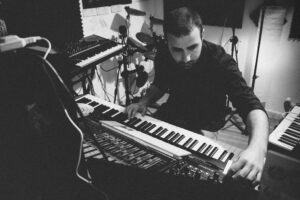
One of the greatest joys is the moment when an idea that exists only in your imagination finally becomes a reality. Every time I start with a project, I always begin with a blank page. I completely abandoned templates, etc. I start with nothing in front of me, and when you come up with an idea, there’s a special feeling when you hear it for the first time.
Another great joy is collaboration. Film composition is not an isolated art form. You are constantly communicating with directors, producers, editors, sound teams, and other artists, and they can inspire you in many different ways.
The challenge is, for sure, that you have to serve someone else’s vision while still bringing your own identity to the project. You have to learn when to insist on an idea and when to let it go.
Deadlines can also be challenging, especially when you are working on several projects at the same time. But, talking for myself, those limitations sometimes make me more creative.
Is there any advice you would give to someone who wants to pursue a career as a composer? What do you wish you’d known when you were starting out?
My biggest advice is to write as much music as possible. Don’t wait for someone to give you an opportunity before you start composing. Create your own opportunities; try to reach out to people in the business.
Study music, study cinema, watch films and listen carefully to scores. Try to understand not only what you like, but why you like it.
I would also tell young composers not to become obsessed with comparing themselves to other people. Everyone has a different path, a distinct voice, a different story.
When I was starting out, I wish I had understood earlier that building a career takes time. Talent is important, but persistence, professionalism, relationships, and the ability to keep learning are just as important.
And perhaps most importantly: don’t be afraid of failure. Every project teaches you something.
Failure is often one of the best teachers in creative work. Is there a specific failure or rejected piece from your career that you look back on as a crucial turning point for your growth as a composer?
There have been projects that didn’t work as I had hoped, and there have certainly been moments when music I believed in was rejected.
But I’ve learned that rejection is not necessarily a judgment of your value as a creative. In film, music has to serve a particular story, director, and edit. Sometimes a beautiful piece simply isn’t the right piece for that film.
Those experiences taught me to become less attached to my first idea and more open to experimentation. I learned that sometimes the best creative decision is to completely start again.
That lesson has helped me enormously throughout my career.
If you could have a gigantic billboard anywhere with anything on it, what message would you want to convey to millions? What would it say and why?
I would probably write: “Never stop creating.”
I think the world needs people who continue to create, even when they are afraid, even when they fail, and even when nobody is watching.
For me, creativity is not only about achieving success. It is about continuing to explore, learn, and express something that’s uniquely yours. It can be music, painting, making a short movie, writing poems or stories, etc.
Describe yourself in one word.
Tireless
I think that this word reflects both who I am as a person and as a composer. I have always been someone who keeps pushing forward, even when things don’t go according to plan or life puts you in a difficult situation.
Alright Simone, this is one of my favorite parts of the chat. Tell me three fun facts about yourself. For me, it’s always fun to see what each individual says about themselves.
First, I started playing drums when I was around six years old, so rhythm has been part of my life for as long as I can remember. When I was at school, I remember using pencils as drumsticks and playing my textbooks as a drum kit.
Second, although I’m a film composer, I love exploring completely different musical worlds. I can listen to rock, electronic music, classical music, dance music, or a film score and find inspiration in all of them, especially when I drive. I think that my Spotify playlist is one of the craziest ones.
And third, I’m a night owl. I love everything about the night. I love how quiet and peaceful everything feels. I usually stay up late listening to music, watching movies, or just thinking about what I have to do next. I feel like I’m more creative and relaxed at night, when there are fewer distractions and everything seems a little slower.
I love ending the chat with a quote. Do you have a favorite quote or saying that has inspired and motivated you in your life that you can share with my readers?
There’s a specific quote from one composer who influenced me the most. It’s from Hans Zimmer and he says:
“If something happened where I couldn’t write music anymore, it would kill me. It’s not just a job. It’s not just a hobby. It’s why I get up in the morning.”
Thank you for reading my interview with Simone. Check out his website: here.
Follow him on: Instagram