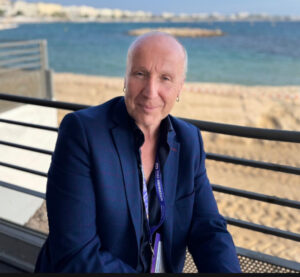
My newest chat is with award-winning Michael Richard Plowman of the United Kingdom and lives on Nevis Island in the Caribbean. He has received two nominations for “Best European Composer”, and he has won 10 Leo Awards and Emmy Honours. He has composed the music for over 150 films and over 1500 episodes of television. An impressive resume for sure! From my chat with him, I can see he has a passion for composing and music, and he loves what he does. His love of music goes back to when he was just a child of 4.
Michael shares with me the joys and challenges of composing music. We talk about failure, and his favorite failure has pushed him to keep going and driven him harder in the course of his life. Read more to find out what that is and everything we talked about.
Introducing Michael…
What do you love about your life right now?
The best thing about my life right now is that I have choice. For so many years, the industry dictated my choices, and even though being a film composer in today’s industry puts a lot of pressure on you, and the expectations that are placed upon you are very high. I make sure that I keep the most essential things in my life important, and my choices. And that is my health, which comes above everything else. My relationships. And where I live. Over the past 30 years, I’ve bounced around from major center to major center, from Los Angeles to New York to Vancouver to London, England to Paris. Basically, you go where the work is. A few years ago, I made the choice of moving to the Caribbean, and then just flying in for the meetings I need to do. I have COVID to thank for that. After COVID, many relationships went digital. So now when I fly in, I go out for my dinners and lunches and breakfasts with my clients and hang out with them, do my meetings, and then go back home. I truly believe that everyone has the choice to design the life that you want to have. When you put the most important things first, everything else falls into place.
Congrats on the premiere of one of your films, Christmas at Mistletoe Manor, which is on Great American Family, for which you composed the music. It sounds like a lovely Christmas film of love and magic with a dash of drama. How did you become involved with writing the score for this film?
Christmas at Mistletoe Manor has been floating around for quite a few years. I was brought on about four years ago when it was still in its script stages. The producer and the director are great friends of mine, and I was there every step of the way from pre-production to shooting to post-production. Over the four years, we had many chats about how we wanted to do the music. In the end, we used none of those creative ideas. Once it all comes together, and you actually start to write the music seriously for it, you definitely use the influence of what you talked about over the past four years. But at that point, it comes to the inspiration you get when you write the first note up against the picture inspiration.
Were there any challenges in writing the score for Christmas at Mistletoe Manor?
I think the major challenge for this score was I had too much time for it. Now I know there’s going to be a ton of composers reading this and going, “Oh my God, give me as much time as I possibly get.” But for me, I want to delve into this world, start writing the music before I lose perspective on the film. Another one of the major challenges of the film was the fact that they tempt it with what I say a hundred million dollars’ worth of film scores? They tempted with John Williams, James Horner, James Newton Howard and a slew of the other top 20 guys in Hollywood today. This was a complete synth score, so I had to make sure that it sounded as real as possible. Because the budget wasn’t available to bring in a live orchestra, it came down to making sure that the samples sounded as great as they could.
From what I know about film composers, your way of storytelling is through your music. When did your journey of composing music begin? Also, was this your dream as a child to become one?
This is a very long answer or a very short answer. I’ve been in music since I was 4 years old, playing trumpet in England. I’ve always wanted to be in music and have always loved it. It’s always been my passion. I wrote my first piece of music when I was eight years old on a Bontempi organ, while living in a little British village in the Midlands. This piece of music was called “Space Music.” Just the black keys. After having my first agent at 14, playing in rock bands, writing pop tunes and hoping to become famous. I ended up moving into jazz and theatre and university after a failed pop album when I was 16. And the rest just moves on from there. If you’d like, I can give you the history of the world according to Michael or leave it at that.
I’ve been listening to the music that you’ve composed, and I love it, especially The Lost World of Atlantis and Age of Heroes. One reason I love films is the film score, especially those from Braveheart and Gladiator. I was listening to your music while researching for our interview and enjoyed the different styles. You have composed music for films, animation, games, and TV shows across various genres, including comedy, romance, and drama. How do you prepare to compose for a TV show or film? What’s your process?
Thank you for the kind words about my music. It is special to me when I hear that people have enjoyed my music and they continue to listen to it. When I prepare for a project, the first thing I do is always ask for a script. I really like to get into the world and the mind of the filmmaker before I see any footage. When I’m scoring for animation, I always like color pictures. There’s something called the Animation Bible, which has all the pictures, and all the scenes, and all the characters, so I can get myself into that zone of what I’m going to be jumping into. From there, I spend a little bit of time listening to the genre that I’m going to be scoring in, just to get my head in that world. Sometimes the filmmaker references a few composers or film scores that they really like that they want me to go into that world of. You mentioned Gladiator. Back when that film came out, I was doing a film called The Invitation. The producer listened to the Gladiator score repeatedly while he was writing, shooting, and editing the film. I can tell you I really got to know that score quite well. This is one of the toughest things as a filmmaker when a producer or director gets used to the music that he’s listening to, and it’s my job to give him something that gives him that same emotion. It can be tough but incredibly fulfilling at the same time.
I was an educator before I got into writing for film and television full-time. And I can tell you one of the greatest things a film composer can do is to learn something every single day. It doesn’t have to be music. It can be as simple as reading a biography, but the idea of learning and growing allows you to come to the table when scoring film with a bigger palette, a more point of reference, and an open mind. Once I start scoring a film, sometimes I work on themes. Sometimes I just dig right in on an action scene, and the themes come out of it. The film is a little different. I’m a morning person, so I get up very early. Actually, 4:00 a.m. After I’ve done my exercises, I head into the studio and start writing. Doing that before I start writing really invigorates me. And my well-being is an intricate part of my scoring. It took me many years to learn this and an overabundance of weight gain. Sitting in a chair for 10-15 hours a day, eating terrible food, and trying to finish a scene. A major part of my process is my well-being. Even during the day when I’m writing, I take my breaks, go for a walk, listen to some music, and then go back again. Sometimes people ask me, “What’s the most important piece of equipment you have in your studio?” Well, in my studio, it’s a little trampoline, one of those little exercise trampolines. Whenever I get stuck, bored, tired, stressed, and a whole slew of other adjectives you want to point at it, I get out of the chair, and I go bounce on the trampoline for 10 minutes. I don’t believe in writer’s block; there is always something you can do to help you on your journey to the finish line of the project that you’re on.
I was hoping you could share with me the joys of composing and also the challenges.
I think the biggest joy for me in composing is the people that I work with. I’ve scored over 150 films and about 2,000 episodes of television. The joy of writing music is not as great as the joy of spending time and working with people. Some of my greatest friends are my clients. Another joy of composing music is when it all comes together wonderfully. One reason why I like to do animation is that it makes me laugh. When I get to do animation, that’s comedy, that’s fun, that’s inventive, and I end up just giggling, laughing my butt off with the scene that just happened. I’m not afraid to cry; in fact, if I can make myself cry with my music, I’ve done my job. Another joy is the fact that I have been fortunate enough to work in so many different genres in so many different countries. Doing this has made me who I am today. Some days I’m working on a documentary in the morning, and then a piece of animation in the afternoon, and because I love writing music so much, it’s not a chore. Even when it’s hard, it’s inspirational to me. This allows me to never give up.
I think one challenge for a film composer is time. Things always take longer than you think. And we always wish we had a little more of it. Another challenge is uncertainty. I’ve read articles on top A-list composers who have had this same issue. The uncertainty of what the client is going to think about the music. Will he like it? Will he hate it? It’s taken many years to not get as personal with the music that I’ve written, so that when I receive comments back, I can respect the comments instead of taking them personally.
I think the greatest challenge as a film composer is the stress that it puts on your personal life or your personal relationships. This is not a 9-to-5 job. It’s not a Monday through Friday job. Take the weekend off and plan for your two weeks off at March break or in the summer. This career is 24/7, 365 days a year. I have worked on Christmas Day, and I’ve worked on my anniversary. No one is going to come and fix the cue for you. No one is going to hold the meeting for you. I’ve been fortunate enough to have been married for thirty years. My wife realized very early and respected the fact of what this job entails and how it affects your life. Now, that being said, it’s your choice to take the time off. It’s your choice to have a life outside of your career. If I can reference back to your first question. What do I love about my life? I have choice, and I always make sure that I make the right choices for my health, well-being, and relationships.
Everyone will deal with failure in their life, and it can be a hard lesson and or life-changing for us. Do you have a favorite failure in your life?
I have failed many times in this career. I think one of the reasons why I don’t stress very much is because I have made every mistake that you can possibly make in a film composer’s life. This career has been the greatest education I could ever have or be fortunate to receive. I heard a fabulous quote not long ago, and it was, “As long as I am willing to fail more than other people are willing to try, I will have the greatest career of my life.”
Now, my biggest failure: quite a few years before my film career kicked off in my late teens, I wanted to be a rock star, and I was writing tunes. It’s irrelevant that they were bad tunes, but I was writing them. I had an album out with Columbine Records out of Los Angeles. A small little label you pay them to release your album. I think it sold about 20 copies. Here’s the moment of failure . I sent these albums off to some bigger record companies to try to get my deal. This was my moment to become a star. I go to the mailbox, and I got a letter from Arista Records, and it says: “Dear Mr. Plowman, thank you for your submission to Arista Records. But please, unless you have a breakthrough in your writing ability, don’t send us any more music.” I still have that letter today. It didn’t make me give up; it actually drove me harder.
Is there any advice you would give to someone who wants to pursue a career as a composer? Is there anything you wish you had known when you started?
Work on the business, marketing, and relationships of this industry just as much as the creative in this industry. When people hire you, they’re not hiring you because they think you’re going to do a good job. They expect you to be a good composer. What is left? The relationship. This doesn’t mean you shouldn’t know your craft to the best of your ability, but the personal side of a composer is just as important.
If you could have a gigantic billboard anywhere with anything on it, what message would you want to convey to millions? What would it say and why?
Create as many incredible moments in your life as you possibly can. Don’t waste a second.
Christmas is right around the corner. Do you have a favorite holiday tradition or film you watch?
I love the Christmas season, even when I get sick of it in July, scoring the next Hallmark Christmas film. We have a tree-trimming party every year with friends and family. Every Christmas Eve, we put on themed T-shirts. I think this year is Star Wars. Last year was Home Alone. Even though my kids have grown up and either run away and joined the circus or have their own lives of their own. We still get together at Christmas and watch a series of holiday classics: Home Alone 1 & 2, The Holiday, White Christmas.
Your Christmas Eve tradition sounds fun! Now, describe yourself in one word.
Happy
Alright, Michael, this is one of my favorite parts of the chat. Tell me three fun facts about you.
I have one foot much shorter than the other. I was born with my feet backwards. One of them is a size 10; the other one’s a size 6. My wife calls me Frodo from the size of my little Hobbit feet.
I have the greatest cartoon bad guy laugh.
I’m a big fan of longevity. I have this thing I tell people. I just turned 60, but I’m on the 120 plan, so I’m just halfway there. I actually just had a t-shirt made with it on it.
Who are your biggest supporters?
I’ve had some incredible people in my life who have taught me so much. Not only about myself, but about life and this crazy industry that we are in.
My wife, Cheryl, has been my greatest, biggest inspirational supporter in my life and career. From the highest of highs to the lowest of lows, she has never once given up on me and always inspired me to continue to grow and better myself. We’ve been together for 30 years. Frankly, it feels like 30 minutes, since I still feel like I’m dating her.
I have three children. Two of them are named after 80’s rock bands, “Boston” and “Journey” All three have been so honest with the support they have given me, and what they have taught me.
I had an incredible assistant for close to fifteen years. Chris Nickel. He now has an amazing composition career of his own. I would say, “When I grow up, I want to be as good as him.”
He taught me that the smallest detail can make the greatest impact.
There are two fabulous Vancouver-based producers named Ian Herring & Chris Bartleman. They have both had tremendous careers in film and television. Not only have he become two of my greatest friends, but they’ve also taught me so much about making sure that every choice I make don’t take lightly, respect it, and when it comes down to it, this industry is just a box of popcorn. Make sure you enjoy it.
I love ending the chat with a quote. Do you have a favorite quote or saying that has inspired and motivated you in your life that you can share with my readers?
“As long as I’m willing to fail more than other people are willing to try, I will have an outstanding life and an incredible career. “
Thank you for reading my interview with Michael.
Follow him on Instagram
Check out his website too here.